
Featured

Pyramid Schemes, or MLMs: what they are, the problems involved, and five questions to protect yourself + a totally unrelated talk about crypto.

First off, what exactly is a pyramid scheme?
A pyramid scheme, also known as a “multi-level marketing” scheme or an MLM, is a popular form of direct selling that involves using one’s social connections to grow a business network. A 1996 academic journal defined direct selling as “face-to-face selling away from a fixed retail location”, usually involving meeting people in social, non-business situations in order to promote the business.

So, isn’t this just affiliate marketing, then?
Well, yes and no. Direct selling and affiliate marketing have very similar contexts and are often used interchangeably, but not all direct selling can be described as multilevel marketing. Within the direct selling industry, there is a particular type of compensation scheme used by most of the popular MLM companies, where sellers are compensated not just for the sales they personally generate. They are also rewarded for the sales generated by the people they recruit, who often form what is described as a “downline”. Because participants can be compensated through multiple levels of recruits (meaning they earn rewards on those they recruit, and also those in their recruits’ downlines, etc.), this is often called multilevel marketing. Since recruits are often encouraged to leverage personal networks in order to build a downline, MLMs are also sometimes referred to as “network marketing.”
MLMs constitute a massive, global industry, with recent estimates of sales as high as ninety billion, while estimates of the reach of such businesses and organisations indicate that as many as half of all respondents had purchased at least one item from an MLM prior to reporting.

So, what exactly is the issue with MLM?
The main issues with MLMs appear to be ethical and structural, meaning that there are often moral issues resulting from the unique business structure. MLMs will often ask people to make a significant initial investment (often framed as some form of “license”) to recruit others who, in turn, pay the same entry fees and recruit others into the scheme. So, in essence, the initial investment was for the opportunity to receive compensation off someone else’s investment, meaning the opportunity to recruit is the actual product.
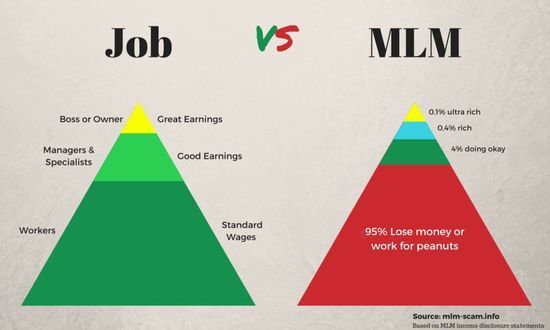
Firstly, such a scheme is unethical because it promises profits and success not based on legitimate marketing and sales of a verifiable product, but on one’s ability to persuade others to invest their own money in a business. Because such a business is not engaged in normal profit and loss, over time the initial capital (generated from investments) runs out and the business collapses. For this reason, those who found MLMs or join early often make a great deal of money, while those recruited later make little or even lose money because capital has been drained to compensate early adopters and there simply are not enough remaining funds or people left available to the network. The second reason such a business is unethical is that it is not in the public interest to have businesses that are focused on recruitment, rather than delivering a product or services to consumers; keeping a business focused on achieving an aim of “public good” helps the business to have sensible and achievable goals, allows them to be accountable to consumers and stakeholders, and ensures that the business will maintain public interest and benefit (which is important for profitability). A business that is focused on “recruitment” and relationships will struggle with understanding and maintaining normal benchmarks and guardrails for a business (such as profit margins, consumer protection, customer service, etc.) and may veer off into unsavory or exploitative practices without proper controls. These reasons are primarily why so many MLMs are often engulfed by accusations of fraud and dispossession and why the term has taken on such a negative connotation in some circles.

Fraudulent MLMs also have a reputation for targeting some of the more vulnerable members of society (such as immigrants, the disabled, stay-at-home or single mothers, college students, and people in developing countries) for scams. Such individuals often have greater and more pronounced financial difficulties, as well as fewer opportunities for advancement and success, so such schemes often appear to be god-sent and are often not questioned as critically; for this reason, it is also particularly damaging and heartbreaking for such individuals when they lose money to MLM scams.


So, are ALL MLMs bad?
Well, not necessarily, but I would say that the vast majority will likely be unprofitable for most people who engage in them. As mentioned earlier, the main issues with MLMs arise as a result of 1) lack of standardised, marketable products, and 2) misguided or exploitative profit generation, so paying attention to those factors can always help you understand if a new business being pitched to you is a predatory MLM or not. This is however not always the easiest thing to do, especially when such businesses are promising fantastic profit margins, so here are five questions to ask yourself before putting your hard-earned money in a new business franchise:

How Is the Money Being Made?
If the money is being made solely or primarily from recruitment, walk away. A healthy business should have reasonably popular goods or services to sell in order for franchisees to make profit. If you don’t know or properly understand what the business sells, no matter how “good the money is” or how “easy it is to do”, walk away. If you are uncomfortable with how the money is made, either because you question the business model or are uncomfortable approaching your social network to sell things to them, walk away. An MLM, of any kind, is not likely to be a good experience for you.


Are There any Products, and Are They Legitimate?
Again: do you know what you’re selling? Can you vouch for the existence and/or quality of what you’re selling? Have you used it yourself? Can you actually recommend this product or service to others, without the incentive of a commission? If you struggle on any of these questions, you need to take a step and really ask yourself if this business is right for you.

How Much Does It Cost to Be Involved?
Most legitimate businesses, even franchises, will only ask you to pay for setup costs and the price of your inventory. Businesses that require pricey registration or licensing fees, which are often not refundable or recoupable after payment, are not showing signs of strength or resilience, and this may be a red flag for a troubled or faulty business model. So, even if the promises of profit are astonishingly high, any MLM business with exorbitant startup costs should be looked at with scepticism.

How Much Work Is Required?
This right here is the trick question. Most people expect that it is the overly complex, or very difficult-sounding job that is the suspicious one, but any MLM that promises you can earn income with little or no difficulty or stress should immediately raise your red flags. Money is not easy to come by, even for those who come by it fraudulently, so whenever someone tells you there’s a “secret” money-making formula to their MLM, take your own money and run!

How Long Has The Company Been Around?
Most MLMs, for reasons detailed above, are notoriously shortlived. While this bodes poorly for those who invested in that particular business, it offers a ray of hope to those of us looking to avoid a similar fate. Longevity is often a good way of gauging how legitimate an MLM is, as a more honest or better run scheme will not struggle with income generation and will therefore stay afloat longer. A business that has been around just a year or two but is “rapidly growing” shouldn’t even pique your interest. A business that was popular two years ago but has largely cooled in interest is a no-go area. Any MLM that has kept the doors open for five years or more can likely be trusted, but you are still advised to go in with your  eyes open and a firm eye on your wallet.

To Conclude: The Crypto Of It All.


Back when I originally wrote this article, I wasn’t really planning on talking specifically about crypto, even though it was actually an offer to invest in crypto that sparked my interest in writing about this. A person that I had only recently gotten to know contacted me about an “amazing business opportunity” that I was then too nice to immediately reject. I agreed to meet and discuss it, and during the conversation this person, a young man, divulged that the “business” was a new cryptocurrency that had apparently been making the rounds on social media and generating a fair bit of buzz. I was extremely skeptical, but I decided to hear him out since I had gone to the trouble of making the meeting. He recounted how he had been going through a tough time financially, and how this had affected his family and their living situation, but now had hope because of this cryptocurrency. The setup involved downloading some app with a number of gamified activities to give the appearance of user agency, but the gist of it was that you needed to invest a certain amount (there were the usual investment “tiers” you find in most MLMs), and recruit other investors “beneath you” to boost your own investment’s value.

So, like, an actual pyramid scheme.
I wanted to warn this person about the severe doubts I had about this “business”, but he had the bright-eyed look of a new convert (we had, incidentally, met through church) and didn’t seem open to having holes poked his hopes of prosperity. So I decided to write this instead, in the hopes that other people in similar situations would read it and be better protected.

So, to address the issue directly: is crypto a pyramid scheme/MLM?
Short answer: Yes.

Slightly longer answer: It’s complicated, but yes.

The profit model championed through cryptocurrency is almost identical to the one used by most MLMs. Most of them aren’t as explicitly identical as the one in my anecdote, but the core principle remains the same: your investment generates profits, not through the creation of useful goods or provision of in-demand services, but through the real or expected injection of new investment, either from you or from others. Without a meaningful public interest or good outside of profit growth, cryptocurrency remains in a strange limbo: it doesn’t do anything but exist, and so there is no motive for anyone other than a potential investor to interact with it, and its growth potential is strangled. Where a product like, say, a brand of peanut butter, or a service like a rideshare app, can experience value growth through sales or partnerships as well as investment, crypto can only grow as a result of actual investment or the expectation that investment will occur. If that investment fails to occur, or worse, if enough people pull their money out, the value will crater, creating a feeding frenzy of people rushing to sell, which will annihilate the value of those crypto assets.

So, doesn’t that just make crypto like an actual currency?
In some ways, yes. It’s literally in the name cryptocurrency. But crypto differs from “normal” currency in some crucial ways that make trading it a much more risky investment than normal forex trading. Ordinary currencies are often backed and secured by the central banks of the countries where they are produced, and their value is pegged to the economic performance of those countries. This gives these currencies a form of stability that allows people who trade in them to rely on them as a meaningful, reliable source of value generation. Regardless of one’s moral stance on foreign exchange trading, there is at least a real (if parasitic) model of value generation with long-term stability. As long as the country in question continues to trade in goods and services, both internally and externally, its currency can be expected to maintain or grow in value, and as long as the country’s central bank continues to exist, there is a process by which that currency can be exchanged to produce meaningful profits for a forex trader.
Crypto, on the other hand, is by nature decentralized, which means there is no central bank securing it, so its value can only be tangentially and questionably linked to that of more stable assets. This also means that there is no institution or entity to turn to if one’s crypto is lost, stolen or suddenly crashes in value. The owner bears all the risk alone.

The lack of centralization also leads to another problem: a lack of regulation. No regulation means that there are no “official” channels through which one can securely trade crypto, leaving one at the mercy of privately-run exchanges with no government oversight. This leaves crypto holders as vulnerable as someone who chooses to bank with a loan shark, but also means that one is never sure about the moral character of those with whom one is trading crypto. Crypto’s primary value as a currency is in its anonymity, which is perhaps why it has become a favorite of unsavory characters looking to conceal or launder ill-gotten wealth.

So, to conclude, if the ethical questions aren’t off-putting, and the glaring risk of total loss of investment with no recourse for recovery is also not a dealbreaker, then one might consider putting money in crypto. But, and this is just my humble perspective, something that seems to blend the worst parts of forex trading and MLMs is not a “business” I would rush headlong into. Watch out.

Featured

Cyclical Econo-Mindsets

To begin with, let us answer the question: what exactly are Cyclical Econo-Mindsets?
The term simply refers to the way lived reality creates mindsets in individual people, and how the collective behaviour or reaction to those mindsets engenders or creates a reality of their own. These cycles can be described, at their basic level, in two forms:
[  ] Scarcity-Adversity
[  ] Kindness-Abundance

[  ] A scarcity mindset occurs most often to people living in a nation or other place where there is relative scarcity of goods, services, or the funds to procure either. This mindset leads people to behave in selfish or self-protective ways, as their minds shift to “survival mode”. But the selfish behaviour itself leads to even greater scarcity/adversity, as people jostle to maintain whatever scarce resources are available, storing, hiding or otherwise diverting them for themselves and those they value. This attitude, when made collective, is a state of adversity, where means are not only scarce, but also attitudes are turned inwards and the collective good is abandoned as impossible to maintain, which leads to even greater adversity as the cycle reinforces itself.


[  ] An abundance mindset, on the other hand, occurs when there is a perception that means are relatively less scarce, and fears of future poverty are low, and so goods, services and the funds to procure them are displayed, invested or exchanged in anticipation of reciprocity. There is also a greater willingness toward charity, as the mindset of abundance leads individuals to give even without an expectation of reciprocity, since means are perceived to be less scarce and fears of poverty are minimized. The collective spirit of goodwill works to boost abundance, which then reinforces more kindness, and vice-versa.

Core Principles
[  ] Everyone has something to offer or hide: this principle indicates that every member of a given society has something to potentially offer to others, or otherwise sequester or hide in anticipation of coming scarcity. This “something” may be goods, services or funds, or even simple affirmations of gratitude, all of which foster abundance mindsets. In the same vein, every member of society possesses something that they can withhold, in whose vacuum scarcity fears and mindsets can proliferate.


[  ] Temptation to “poison the well”: In every given society, there is within every individual the capacity to “poison the well”, or to transform mindsets from abundance to scarcity. This often occurs as a result of real or perceived antisocial vices like greed, sloth and envy, as a greedy or slothful person may poison the well by accepting goodwill and refusing to reciprocate, or a jealous person may actively take on and propagate a scarcity mindset, whether real or perceived, because another individual seems to benefit more from abundance.

Religion in the Modern Workplace: How to Get It Right

Religion unquestionably plays a large role in the everyday lives and experiences of most people, but religious sentiments and ideas are often, by design, conspicuously absent in the modern workplace. The reasons for this are multiple, from the unwelcome difficulty of maintaining diversity and fairness among
religious groups within the workforce, to the risk of discrimination claims by employees who feel their faith or religion has not been valued or respected in the workplace, but the outcome is that most workplaces today assume or even require a strictly secular mindset and demeanor when in the workplace. This prevents a lot of the potential benefits of faith and religion, including on the
worker, from making an impact in the workforce.

Religion is a very effective model for behavioral conditioning, as most major
religions possess guidelines or commandments that instruct followers to model exemplary characteristics like honesty, humility, patience and grace, all of which
make for a more valuable, better adjusted member of staff. Most major religions also have chapter and verse dedicated to exhorting people towards hard work and
perseverance, and these doctrines could have a cultural effect on individual behaviours in ways that increase productivity. These teachings, which are often learned from a young age, can prove as efficient or as motivational as a life coaching session or a work seminar, and have extra significance in the life of the worker because of their spiritual connotations.

There are also social reasons why religion can be a positive in the workplace: it creates an almost instant sense of deep community, which allows us to understand each other better without as much interaction required. In times of stress or actual distress in the workplace, it helps to have a sort of “shorthand” for confronting such crises that is shared by the people you work with, and religion can fill that space for many people.
Religious belief can be highly motivating, and the ability to share that motivation can be very useful in situations where adversity or challenges are also shared by individuals in the workplace.

Potential Landmines
There are, however, a few potential issues one must be on the lookout for if one is
going to permit faith and religion into the workplace, in order to ensure
maximum reward, as well as to minimize risks and costs, of workplace religious
engagement.

Workplace partisanship: A significant risk with introducing religion to the workplace is that such a move could polarize the office atmosphere by making some workers feel they are excluded or intimidated because of their status as members of a minority religion, or because of their lack of faith or religion, while providing others who are of faith with a community resource that is denied to the other members of staff. It is therefore highly important, when introducing
religion to the workplace, that management ensures that it does not come from a place of enforcement or exclusivity. Allowing membership or engagement to be strictly voluntary, as well as emphasizing the open and inclusive nature of the initiative, will help employees get the maximum benefit of faith in the office without allowing it to become a lightning rod.

Politics: Faith and religion are inherently political, because they give us moral
guidance and instructions, which then shape how we observe and act in the world. As every faith or denomination has its own internal moral and social politics, it is important to emphasize to staff that faith-based endeavors in the workplace have a strictly unifying intention, and that controversial talks, proselytizing, and apologetics are inappropriate and unacceptable behaviors at work. Religious discussions and interactions should be of a tolerant, open-minded and uplifting nature, which is incompatible with political arguments.

Special Accommodations
Different religions have different customs, and sometimes those customs may cause a worker to need special accommodations that workers of other faiths or religions do not need. When this need occurs, for example, when a Muslim employee requires a longer lunch break on Fridays to accommodate their prayers, or when a Catholic worker can no longer partake in catered office lunches during Lent without a meatless option on the menu, they raise questions about whether it is more fair to be equitable or accomodating. These challenges could surface at any business or workplace, but they will be of key focus in a workplace that makes faith and religion a priority. When deciding on whether to grant a special accommodation, it is important to ask whether the accommodation is sustainable (could it feasibly be offered to every employee that needs it?), legitimate (is it a common or an acknowledged accommodation?) and fair-minded (is it an accommodation that most people can or want to use?). As long as the accommodation can meet this criteria without significantly disrupting workflow, then it should be considered.

In conclusion, religion can be a beautiful and powerful part of a person’s life, and is deeply significant to many workers, but an office or business that intends to accommodate religion in a modern setting must take concrete steps to protect religious engagement either from distracting workers, or from being manipulated as a tool of division that hinders workflow.

A Conversation About Gig Work, in the African Context

So what exactly is this “Gig Work” everyone is suddenly raving about?

“Gig work” typically refers to any short-term or part-time work carried out by temporary workers or employees; the term originates from the American word gig, which was used to refer to bookings and engagements by musical performers, and that concept of a time-limited engagement has carried over into this “second life” for the phrase. In practical terms, a gig worker is your bus or lorry driver that parks somewhere and waits for passengers. A gig worker is also your caterer that packs all her utensils onto one of those buses or lorries, and travels to the home of a family celebrating the naming ceremony of a new child, as well as the midwife hired to safely deliver the child. In essence, gig work has always been a key part of our social and economic arrangements, because it arises from the simple logic that we don’t need all the things we need all the time. There are just some needs and desires we have, as people and as consumers, that are designed and/or intended to be ephemeral or fleeting, and gig workers fill those inconsistent yet necessary spaces.

So if this “gig work” has always been here, why am I suddenly hearing so much about it now?

While gig work and economies have always existed, our increasing ability to connect with each other on a one-to-one basis, powered by the rise of Internet and social media, is making gig work more plausible and accessible for a much wider range of individuals and activities than previously obtainable. On the flip side of that, the rise in automation is making the labor-intensive “9-5” model of working less viable for a lot of employers, which reduces their personnel requirements in terms of both workforce and work hours. This translates into a reality for workers where there are fewer jobs available in general, as well as one where a smaller proportion of available work is full time employment. This mix of opportunity and expediency is fueling a sharp jump in how many of us are engaged in gig work, either as the primary mode of income generation or as a supplement.

Okay, so what does this mean for African countries?

Africa, and Africans, seem to have embraced gig work, with new and existing “gig work” platforms making footprints on the continent and near-invariably finding both a curious and accepting market as well as a glut of able and qualified workers in the urban and suburban areas; however, many African nations have significant amounts of rural areas where the efficiency of such work remains untested and, in many cases, currently untestable from a logistical perspective. As many of the top-down factors driving the rise of gig work and economies are not significantly affected by rural-urban divisions, the need for such work, or the lack of alternatives, will afflict rural areas similarly to more urbanized areas, so it is important that such areas are given the infrastructure to be able to support such work, so as not to worsen current rural-urban inequities.

Wow! So what does it mean for me specifically, as an African worker in an urban area?

As individuals, most of us will come to engage with gig work, either as consumers or as providers, if we have not already done so. For the individual, gig work can mean opportunity: there are now chances to gain employment from the comfort and safety of your phone screen, without the hassle of sending in a wordy cover letter or sitting through hours of interviews. For an increasing variety of jobs, you can even do either part or sometimes all of your work over the phone or internet, which completely changes everything about how you work, from your schedule to your budget, even to your personality or sense of fashion. But there are also a few drawbacks. Gig work is notoriously fleeting, and something as little as a very bad customer review or a stolen phone can leave you completely without your source of income. Most times, it also doesn’t yet pay as well as full time work, and the temporary nature of the work means you can never take your income for granted. And it is more risky, both in the sense that gig jobs tend to more often put people in direct contact with customers, which comes with an element of risk; there are also often less insurances or other protections from the gig employers, so much of that risk is borne solely by the gig worker. The African context is not much different, with the high levels of rural-urban migration experienced by major cities in African countries supercharging both the opportunity and the risk of gig work, so the African worker needs to both be open-minded as well as cautious. Basically, chase your hustle but shine your eye.

The Last Wellness Plan You’ll Ever Need

A corporate wellness program you’ll actually use.

The health and fitness of employees are becoming increasingly important in a corporate environment since their health and well-being are indicators of the organization’s overall health. This has placed pressure on management to focus on improving staff’s health status factors through corporate wellness interventions. This, however, may only sometimes have the desired effects, as there needs to be more communication about what constitutes wellness, how to carry out effective wellness programs, and how to carry along staff who may need more motivation to participate. This article will cover why many wellness programs fail to achieve their goals, the fundamental principles to keep in mind when attempting to create one, and practical steps to help you effectively execute the plan in a way that genuinely benefits your workforce. 

Many wellness programs need help with the same issue: a fundamental miscommunication about the purpose and goals of the program between management, staff, and facilitators. This is because of the (highly vague and loaded) stated final goal of wellness exercise: employee engagement. Employee engagement has recently been overused as a term in corporate language, leading to its existence as a “catch-all” word that describes almost any kind of employee activity. 

“The term “engagement” can describe sending an email to a co-worker about work or simply sending a text message. Because of its broadness, the term is unhelpful for discussing particular workforce goals, as confusion may set in at any stage and cause the program to run off track. For these reasons, three basic principles must be adhered to by management for the wellness program to be well-received by and successful with members of staff.

Top-down approach: For a corporate wellness program to be successful, there needs to be a concerted effort emanating from leadership and management, detailing both what the larger goal of the program is for the company, as well as what is expected of each employee. By providing this clarity, employees will be able to understand the changes required by the program, thus reducing resistance and apathy. As a result, workers will be more accountable to each other and the program because they can connect their personal growth or actions with the outcome of the workforce and company.

Intentional: Short-term or unfocused interventions are likely to be less effective at promoting wellness in the workforce because such interventions often need to be appropriate and sustained to be appropriately effective. Plans that involve hands-off approaches like health risk assessment testing or offering participation incentives can be valuable parts of a program but will be utterly inadequate if used in isolation. Learning about health risks without accompanying solutions can be demoralizing for a worker, and incentives could be counterproductive to engagement by linking it to rewards that may sometimes not be available. 

Strategic: For the program to be effective, it has to be well-tailored, both for the goals it intends to achieve and for the people that will engage in it. To accomplish this, the program must address the engagement issue it is meant to solve; for example, a weight loss program that only involves exercise with no dietary guidance is likely to achieve poor engagement. The program should also make sense for the workers, meaning it should be administered at a time and in a place that is conducive for all employees and allows for maximum participation. Effective than one that offers both.

Practical Steps to Setting Up Your Wellness Plan/Program

As you frame your thought process for your plan around the principles above, there are also concrete actions you can take to ensure your wellness program is a success.

Define your goals: As said earlier, it is essential to clearly state what the purpose or goals of your program are, make those clear to potential participants or facilitators, and also define what success at the program tangibly looks like for the company and how that success can translate to increases in management or employee satisfaction and growth, respectively.

Set a budget: A budget is an excellent way to set artificial limits or “guardrails” around the program and prevent it from spiraling into a larger or more complicated endeavor than expected. A budget will also send a message to any facilitators about what kind and level of service your workforce requires, ensuring communication is maintained.

Set up a planning team: For a wellness program to be successful, it is crucial to involve the employees who will benefit from it in the planning process to make plans that will engage and motivate them. In addition, it prevents logistical issues like time/date conflicts from being pre-emptively resolved among workers.

Make it top-of-mind: Promoting and maintaining awareness of the program details within the office is the best way to ensure maximum participation. You can do this by internally marketing the program. In such a case, short-term incentives may be more effective.

The history of pizza, and how travel shapes how and what we eat

Pizza is one of those food items that everyone has definitely seen or heard about at some point, even if we may have never tasted it before. This popularity is a testament, in many ways, to the journeys pizza has made around the world, and how that movement exposed the dish, both to innovation and also to global exposure and later dominance. Pizza seems to have rather obscure origins, as the idea of eating a baked bread dish with vegetable toppings has been common in the Middle East and ancient Greece and Rome for centuries; there were also similar recorded practices in parts of Asia, such as India and China.

However, the highly recognizable dish topped with tomato sauce and cheese was reportedly invented at the tail end of the nineteenth century in Naples, Italy, by a man called Rafaelle Esposito. Prior to this, pizza had developed as a street food amongst the working classes of Naples, who were largely poor people and immigrants. At the time, French cooking was the popular option for wealthy Neapolitans, but a chance tourism visit to the city by the then King and Queen gave Esposito a chance to showcase his homegrown dish in a big way. The royal couple responded favorably to the dish, and it took off around the country afterwards due to word of mouth.

Surprisingly, pizza did not become the globally recognized dish it is today until the post-WWII period, when emigrant Italians in cities like New York and London began to make and sell pizzas to their new neighbours. Soldiers who had been stationed at Italy had already acquired a taste for pizza, so it wasn’t long before the dish was quite popular within the US as well. The US cultural industry, headed by Hollywood, then helped to cement pizza’s position as a globally iconic dish, exporting the taste for it to a global audience using media channels like music and films.

Today, pizza is one of the most regularly consumed food products in the world, and this success can be traced by following the paths of travel that have been associated with it. From the poor immigrants of Napoli trying to subsist on a cheap dish, to the visiting monarchs of the Italy taking a chance on an unfamiliar local cuisine, to the New York emigres capitalising on the nostalgia of past military service to popularise their product, travel and the movement of people have been instrumental to pizza’s evolution from a lowly street food to the best known dish on the planet.

How Visual Content and Storytelling Drives Travel Destination Marketing

As much as we may travel around the world in search of luxury, comfort and excitement, the primary thing that drives tourism globally is our human desire to experience and interact with new people, places, ideas and narratives. In other words, it is our unique stories that attract us to each other, and it is for that reason that storytelling is of the highest importance in marketing a destination.

But for storytelling to be effective, it has to be visible and creative, and this article will cover the best ways to frame travel stories to attract the widest audience.
Creation and sharing of content have always been crucial factors in promoting travel destinations to a wider audience. Art and literature, from postcards to film, have historically been used reliably to show the more beautiful and inviting aspects of a particular destination or culture, and this dynamic has only gotten more relevant today.

Social media, and in particular visual content hosted on SM platforms, can help to organically boost your destination marketing by providing potential travellers with a concrete and compelling narrative about the destination.
Creating visual content, such as pictures and videos, that capture the aesthetic or cultural essence, as well as the physical highlights, of a destination can help the traveller feel more secure and excited about the trip before having even stepped out the door. Using pictures and videos as the centerpiece of destination marketing allows you to differentiate your destination from others with the uniqueness of the content you post about it. Visual media allows you to inject a sense of local personality into the marketing, and that adds authenticity to the content and makes it more relevant.

Visual content is also useful because of the ways that tech platforms like Google have made such content highly accessible and interactive on their pages. The inclusion of easily searchable content in destination marketing will allow for more organic engagement with that content (such as through Google searches) while potentially providing more visibility to that particular destination as a keyword in future searches. Visual content can also be repurposed for multiple different formats and platforms, giving it even more flexibility and giving you more options and opportunities for promotion, and will remain as a passive form of online marketing even after any promotional campaign has concluded.
In a nutshell, content and narratives are a compelling way to sell or promote travel destinations, and visual content appears to be the most effective way to achieve this goal. Using or including visual media content, either images or videos, in destination marketing can increase the visibility of a destination and show more of the unique personality of that destination that makes it a great place to visit.

Design a site like this with WordPress.com
Get started